
Blog
What Is Rugged Device Management Complete Guide for Enterprises
Discover what rugged device management is and how enterprises manage rugged devices, handheld scanners
- Author
- Anna
- Published
- Mar 9, 2026
- Updated
- May 11, 2026
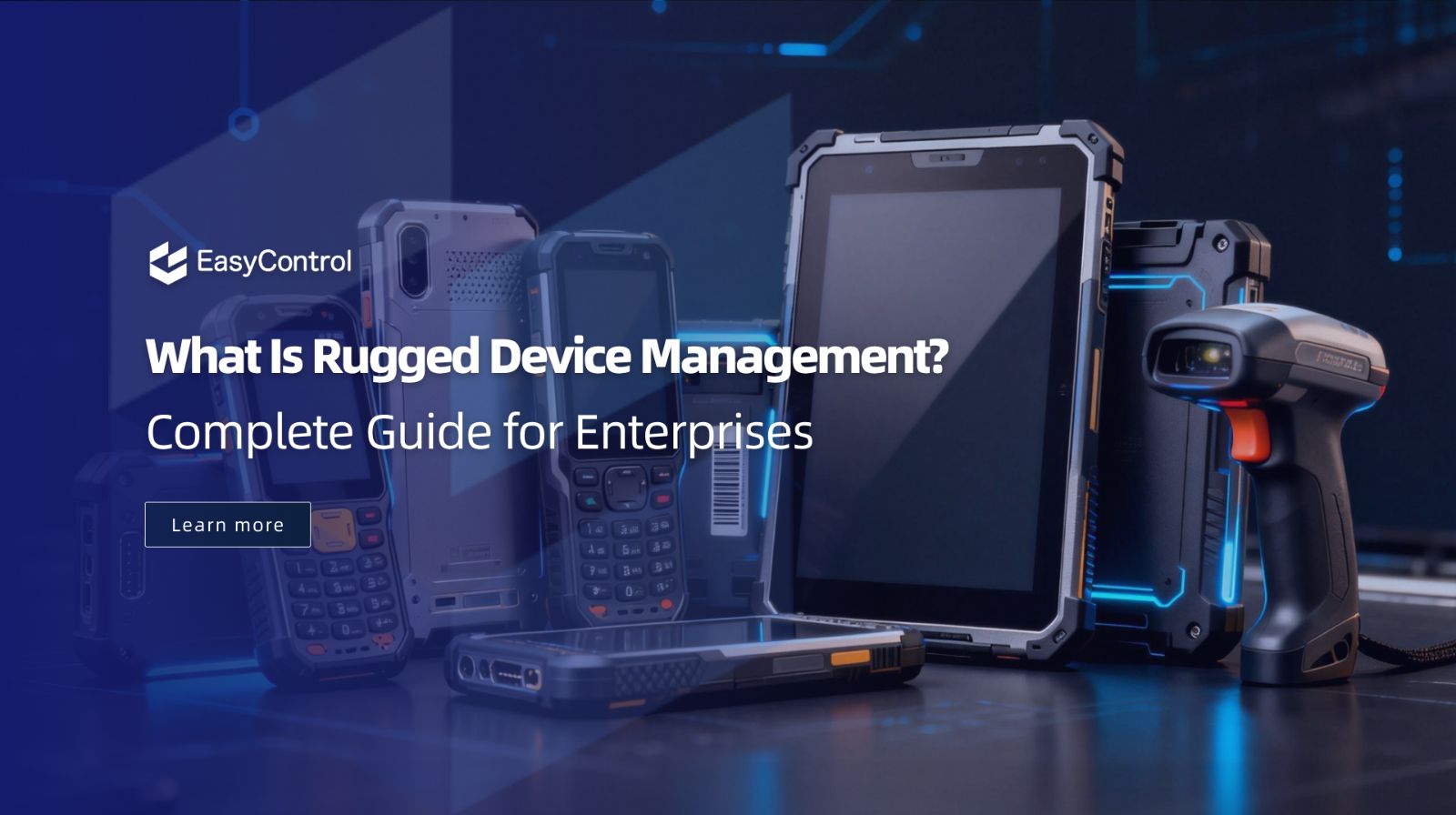
At warehouses, factory floors, delivery fleets and field service sites alike, rugged devices have become essential tools of frontline operations. Ranging from barcode scanners at distribution centers to industrial tablets mounted onto forklifts, these endpoints enable real-time data collection as well as mission critical workflows.
As IT teams expand deployments, many discover that traditional office-focused Mobile Device Management tools do not adequately protect devices in harsh environments like dust, moisture, vibrations, and temperature variations – thus the need for rugged device management solutions becomes apparent.
Businesses need devices for not just deployment, but also management in high-intensity scenarios like rotating shifts and distributed teams. Logistics, manufacturing, retail utilities, and field service industries rely increasingly on ruggedized systems.
1. What Is Rugged Device Management?
Rugged Device Management is an extension of Mobile Device Management that’s tailored to industrial hardware. It is different from traditional smartphone management because it emphasizes stability, remote operability, and security.
Rugged device management is at its heart a way to ensure that devices are secure, optimized, and online–from the initial deployment, provisioning, real-time monitoring and troubleshooting through updates and decommissioning.
1.1 The Difference Between Standard MDM and Rugged Handheld Device Management
Standard MDM solutions are designed primarily for corporate smartphones and tablets used in office settings. Their features typically include app distribution, password enforcement, and configuration management.
In contrast, rugged handheld device management is engineered for frontline and industrial environments. It emphasizes:
- Kiosk mode enforcement for task-specific operation
- Stability under high workloads
- Monitoring and Alerts in Real Time
- Reliable synchronization under weak networks
- Remote diagnostics and control
- Large-scale policy deployment
Industrial workflows demand reliability beyond what conventional office MDM tools typically provide.
1.2 Types of Rugged Devices
Different rugged devices are used by different industries and each is designed to perform specific tasks.
1. Rugged Smartphones: Rugged smartphones have long been utilized by industries across multiple fields for performing specific tasks and are used extensively across industries ranging from logistics and field inspection to real-time synchronization applications. Their rugged construction provides IP67+ protection with long battery lives for real-time sync capabilities.
2. Rugged Tablets: Used extensively in warehouse and manufacturing plant management, rugged tablets provide batch configuration, zero-touch deployment and integration into operational dashboards for seamless management operations.
3. Barcode Scanners: Essential tools in warehouse and retail settings, these scanners enable users to read damaged barcodes as well as track battery performance over time.
4. Handheld Industrial Terminals: Handheld terminals equipped with barcode scanning capabilities as well as RFID, NFC, and GPS technologies can be useful tools in manufacturing, transportation, energy production or any sector that demands multitasking and strict permission control, like manufacturing.
2. Why Businesses Need to Manage Rugged Devices Properly
Effective rugged device management is integral to industrial operations; its success directly correlates to productivity, data protection and revenue protection. Companies must strategically oversee rugged devices so as to guarantee consistent performance and operational continuity.
2.1 Harsh Environment Usage
Monitoring hardware can detect anomalies sooner, extend its lifecycle and avoid unexpected disruptions by actively managing rugged devices. Businesses should actively manage rugged devices for increased productivity.
2.2 Distributed Workforce
Costly technician visits often add unnecessary delays. A centralized control system gives IT departments the power to remotely configure, upgrade and troubleshoot devices thereby cutting downtime considerably.
2.3 Security Risks
Rugged devices host crucial operational data, customer information and production metrics that may be at risk in remote environments. Strong encryption techniques, role-based access control measures and remote wiping devices may reduce these risks and protect data in these instances.
2.4 Device Downtime = Revenue Loss
A failing scanner in a warehouse or terminal crash on site can halt operations and result in production bottlenecks or delayed shipments with revenue lost altogether as a result of disruption.
3. Key Features of Rugged Handheld Device Management Software
The modern platforms are equipped with specialized industrial tools.
3.1 Remote Monitoring
Modern rugged device management solutions provide remote device management and real-time insight into device health, including battery life, storage capacity, and performance metrics giving IT departments real time visibility of potential problems that might otherwise develop quickly into costly emergencies.
3.2 The Location Tracking System
Using GPS and geofencing, organizations can manage rugged devices at multiple locations. It ensures accountability of assets and helps prevent device theft in large operations.
3.3 Remote lock & wipe
IT administrators can lock and erase devices instantly if they become lost or stolen, protecting against data breaches.
3.4 App Management
Administrators can use silent updates, whitelist business-critical apps, and block unauthorised installations to manage rugged devices.
3.5 Kiosk Mode
Companies can utilize rugged device management solutions to restrict employees to tasks approved by the business and help ensure workers only perform approved tasks on company devices. This ensures workers remain focused solely on work tasks approved for completion by management.
3.6 OS Updates
Rugged handheld device management that includes OS upgrades and patches that are controlled to ensure security without causing disruptions.
3.7 Bulk Enrollment
Bulk enrollment and zero-touch provisioning enable enterprises to quickly configure hundreds or even thousands of rugged devices at the same time, saving both time and resources in doing so.
4. Industry That Rely on Rugged Device Management Solutions
Rugged device management services can play an essential role in industries that depend on uptime and operational precision for success.
4.1 Logistics & Transportation Services
Companies using rugged handhelds for delivery fleets to optimize routes and verify delivery confirmation can benefit greatly by employing centralized management systems for these devices in all regional hubs, while still guaranteeing real-time tracking and dispatch coordination.
4.2 Warehouse and Inventory Control Management
Barcode scanners and tablets play a vital role in stock updates and order fulfillment. IT teams must carefully oversee them to ensure scanning accuracy, app stability and continuous connectivity – WPM plants also utilize these.
4.3 Manufacturing Plants
Production lines depend on industrial terminals for real-time monitoring. Remote diagnostics help avoid downtime that would disrupt assembly processes altogether.
4.4 Retail & POS Operations
Rugged POS terminals excel at handling transactions efficiently in high-traffic environments. Their remote configuration enables instant pricing updates and promotional rollouts across all branches.
4.5 Field Service & Utilities
Utility technicians depend on rugged handheld device management for inspections and reporting purposes, while centralised oversight provides task completion verification while safeguarding infrastructure data.
5. Common Challenges in Rugged Device Management
Enterprises often encounter several hurdles when trying to effectively manage rugged devices.
- Device Fragmentation: Multiple brands and OS versions complicate policy enforcement efforts, making updates cumbersome and policy enforcement challenging.
- Remote Troubleshooting Challenges: As teams attempt to manage rugged devices at scale, remote troubleshooting issues become even more of a headache.
- Unauthorized Application Installation: Developing applications on one’s own takes considerable resources and could pose security threats when installed onto an already vulnerable network.
- Network Connectivity Issues: Faulty signals slow command execution and synchronization processes, delaying their completion and becoming the source of frustration for network admins.
- BYOD vs COPE Security Concerns: Balancing flexibility and security complicates comprehensive rugged device management strategies.
Addressing these challenges requires a platform specifically engineered for industrial-grade deployments.
6. Rugged Device Management in 2026 and Beyond
Automated and connectivity innovations will play a central role in rugged device management in the next stage.
- AI-Driven Monitoring: Machine learning algorithms will analyze device telemetry in order to predict hardware failure and performance degradation accurately.
- Predictive Maintenance: Preventative alerts will significantly cut downtime and extend device lifespan, saving both money and downtime.
- 5G Enabled Remote Operations: Ultra-low latency connections can enhance real time data synchronization and remote control capabilities, giving companies greater precision when monitoring operations or controlling them in real time.
- Zero Touch Deployment: Automated configuration allows enterprises to expand rugged device management quickly without resorting to manual setup procedures.
As digital transformation unfolds, businesses will come to depend on more advanced and automated rugged device management systems.
The industrial environment requires more than simple mobile surveillance. Effective management of rugged devices guarantees stability in operation, secures sensitive information, minimizes the amount of downtime, and increases the lifespan of devices.
Businesses that use the latest MDM devices specifically built to work in industrial environments will be able to be more assured in managing rugged equipment at a larger scale while increasing their efficiency and reducing costs of ownership.
If you work for a company that relies heavily on mobility for frontline operations, now is the right time to perfect your strategy to manage devices with a rugged approach. Start a demo or try a free trial to see the ways that advanced device management can help your organization move to the next level of digital change.
Tags
Related Articles
Blog
Endpoint DLP Explained: Secure Enterprise Data in Hybrid Work
Discover how Endpoint DLP and UEM secure enterprise data in hybrid work with device control, app management, and real-time monitoring
May 7, 2026
Blog
Enterprise App Management: Build Secure App Store & Policies
Learn how enterprise app management helps businesses control apps, improve security, and automate deployment using app stores and policies.
Apr 15, 2026
Blog
What Is Unified Device Management? Cross-Platform Guide (2026)
Learn how unified device management helps businesses manage Android, iOS, macOS, and Windows devices from one platform with better security and efficiency.
Apr 14, 2026
Continue exploring EasyControl resources
Go deeper with documentation, strategic guides, customer stories, and video content across the resource center.