Blog
How to Choose the Right MDM Solution: A Practical Guide for Modern IT Teams
Selecting an MDM solution involves more than simply comparing feature lists. Organizations today need to manage an ever-increasing variety of endpoint devices, from smartphones and tablets through laptops and kiosks, POS terminals, digital signage displays, and rugged handhelds owned by employees to IT teams’ own devices. As device environments grow more complex, IT teams often...
- Published
- Jun 24, 2026
- Updated
- Jun 24, 2026
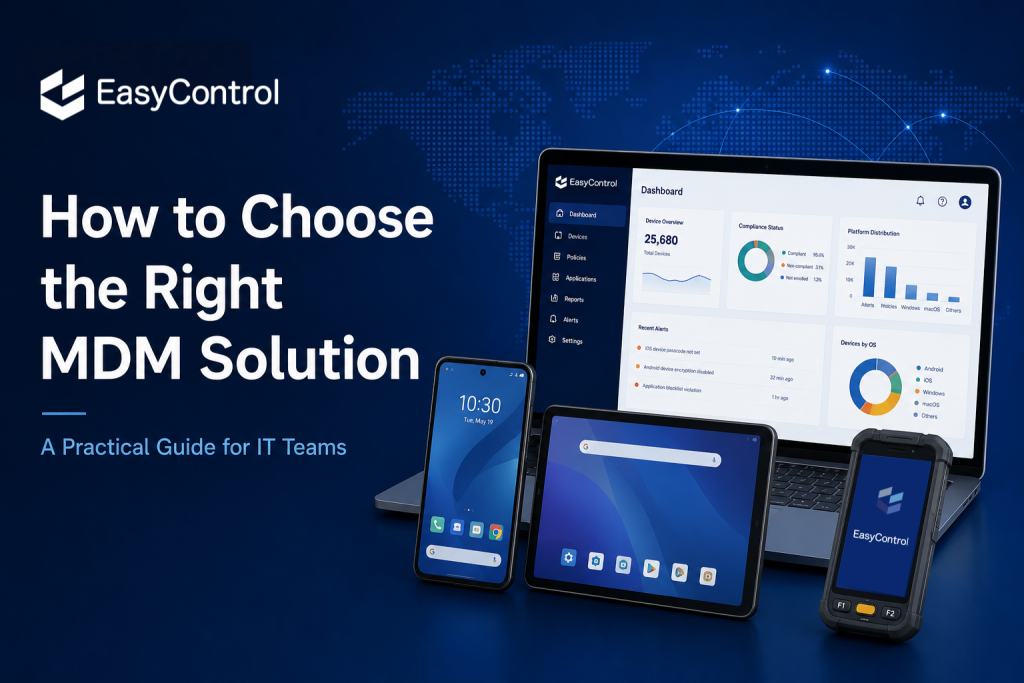
Selecting an MDM solution involves more than simply comparing feature lists.
Organizations today need to manage an ever-increasing variety of endpoint devices, from smartphones and tablets through laptops and kiosks, POS terminals, digital signage displays, and rugged handhelds owned by employees to IT teams’ own devices. As device environments grow more complex, IT teams often discover that managing these endpoints at scale presents not just functional limitations but an additional operational overhead that must be covered.
An effective MDM deployment should simplify device management, increase security, and lessen administrative workload. In this guide, we explore key considerations organizations should keep in mind when assessing MDM software and discuss common device management challenges facing modern enterprises.
1. Why Simplicity Matters More Than Feature Count
Organizations often look at features when making MDM software decisions. This shouldn’t be their main focus when selecting software platforms ease of deployment, management and maintenance should always come before functionality when considering MDM solutions.
Common challenges include:
· Long onboarding and training cycles for administrators
· Complex policy creation and device enrollment processes
· Inconsistent user experiences across device types
· Frequent manual intervention for updates and troubleshooting
· Limited visibility into device compliance and security status
Organizations often gain more from platforms that help streamline routine management tasks than from those boasting elaborate features.
An effective MDM solution should enable IT teams to automate device enrollment and configuration; streamline policy administration processes; and minimize operational workload when managing large device fleets.
2. Unified Management For Multiple Operating Systems
Most organizations maintain mixed device environments. A retail business may utilize Android-based POS systems, iPads for customer interactions, and Windows workstations alongside digital signage displays and employee smartphones; logistics firms commonly manage rugged Android handhelds alongside Windows laptops and shared mobile devices while healthcare organizations may utilize tablets, workstations, and specialized endpoints in deploying multidevice environments.
As managing devices across different management systems can lead to operational inefficiency, inconsistent policies and fragmented reporting, many organizations are opting for integrated device management platforms that support multiple operating systems from one console.
EasyControl supports centralized management for:
· Android
· iOS and iPadOS
· Windows
· macOS
· Linux
Our platform integrates with enterprise enrollment frameworks such as Google Android Enterprise and Apple Business Manager/School Manager for seamless device provisioning and deployment.
In addition to smartphones and tablets, organizations can manage a wide range of endpoints, including:
· POS terminals
· Kiosks
· Digital signage
· Self-service terminals
To date, EasyControl has managed more than 150 million devices globally across diverse industries and deployment environments.
3. Four Common Device Management Challenges
Scenario 1: Restricting Company-Owned Devices to Business Use
Organizations that issue company-owned devices need a way to safeguard against unapproved application installations and non-business use of these devices, often by employing Kiosk Mode which limits users to approved apps while blocking access to app stores, browsers or any non-essential functions such as browsing or video services.
Work Profile capabilities offer businesses that require greater agility the flexibility they require by segregating business and personal content on one device, making it possible for administrators to remove corporate files when required without impacting personal content. This also gives administrators more freedom in terms of removal.
Scenario 2: Deploying Application Updates to Distributed Devices
Updating hundreds or thousands of devices can be challenging, particularly when devices operate across multiple locations and network conditions.
Modern MDM software platforms typically provide:
· Scheduled deployments
· Device group targeting
· Location-based deployment rules
· Network condition controls
· Staged rollout capabilities
These features help organizations reduce deployment failures and minimize operational disruptions during software updates.
EasyControl supports task-based deployment workflows that allow administrators to control when, where, and how updates are delivered across device fleets.
Scenario 3: Protecting Leased or Shared Devices
Organizations that lease devices or provide shared-use hardware often need mechanisms to prevent unauthorized modifications, tampering, or asset loss.
Device locking technologies can help enforce usage policies and restrict access when predefined conditions are not met.
EasyControl’s Device Lock functionality combines encryption technologies with system-level restrictions to help organizations protect leased assets and reduce the risk of unauthorized use or resale.
Scenario 4: Securing Corporate Data on Employee Devices
Bring Your Own Device (BYOD) programs can improve flexibility and reduce hardware costs, but they also introduce additional security considerations.
Organizations must ensure that sensitive business information remains protected even when employees access corporate resources from personal devices.
Typical security controls include:
· Device encryption enforcement
· Screenshot restrictions
· Camera controls
· Bluetooth management
· USB transfer controls
· Remote wipe capabilities
Compliance monitoring is equally important. Devices that are rooted, jailbroken, or running unsupported operating system versions may require restricted access to corporate applications and resources.
EasyControl provides more than 100 security policy controls to help organizations implement and enforce these requirements.
4. Evaluating MDM Solutions at Scale
Beyond feature comparison, organizations should assess whether an MDM software platform has been field-proven in real-world deployment environments. Crucial factors for evaluation may include:
Ease of Deployment
Platforms that feature policy templates, automated enrollment workflows and simplified onboarding processes can reduce deployment time and administrative effort significantly.
EasyControl includes preconfigured policy templates tailored for common business scenarios, enabling newly registered devices to instantly inherit appropriate configurations upon enrollment.
Scalability
As businesses expand, device management requirements become more intricate. An MDM solution should support large device fleets across various regions while guaranteeing consistent performance and policy enforcement.
Product Development and Support
Device ecosystems evolve, necessitating frequent updates to support new operating system versions, hardware platforms and security needs.
Organizations should carefully assess a vendor’s investment in research and development, product roadmap development and release cadence when assessing long-term platform viability.
5. The Future of Device Management
The scope of the MDM solution continues to expand.
In addition to traditional smartphones and tablets, organizations increasingly deploy:
· Smart kiosks
· Digital signage
· IoT devices
· AI-powered endpoints
· Industrial equipment
· Self-service terminals
These devices must be managed centrally, configured remotely, and updated regularly; monitoring will also need to occur, and support will need to be provided over their entire lifespan.
Due to this evolution, device management platforms are rapidly moving away from traditional MDM solution capabilities towards comprehensive unified device management approaches that support various endpoint environments with one platform.
EasyControl provides device management, remote configuration, and over-the-air (OTA) update capabilities via both management consoles and SDK/API integrations, making device lifecycle management seamless from deployment through retirement.
Device management has quickly become an essential IT capability within many organizations, alongside networking, cloud infrastructure, and endpoint security. Selecting an adaptable platform that meets evolving business demands becomes ever more crucial as an essential strategic decision
FAQs
Can EasyControl manage Android, iOS, and macOS devices from one platform?
Yes. EasyControl supports Android, iOS, iPadOS and macOS devices through one management console for efficient management of enrollment policies, applications and security settings across a spectrum of operating systems. Organizations no longer need to maintain multiple management platforms!
How long does deployment typically take?
Deployment timelines depend on the size and requirements of an environment. With standard deployments, organizations typically enroll devices and apply initial policies within one to two days by using predefined templates and automated deployment workflows.
Does EasyControl support enterprise security and compliance requirements?
EasyControl offers comprehensive enterprise security features, such as device encryption, compliance monitoring and audit logging as well as remote wipe capabilities and private deployment options. It has earned certification under ISO 27001, ISO 9001 and ISO 14001.
Can EasyControl manage devices across multiple countries and regions?
Yes. EasyControl utilizes global distributed cloud infrastructure and acceleration nodes to support organizations operating across various geographic regions.
Does EasyControl support Managed Service Providers (MSPs)?
Yes. EasyControl provides multi-tenant management capabilities designed specifically to support managed service providers (MSPs). MSPs can utilize these features to oversee multiple customer environments from a central platform.
Tags
Related Articles
Blog
What Is iOS Device Management? Complete Guide
Why iOS Device Management Matters for Businesses iPhones and iPads have become useful tools for businesses of all sizes. Employees use them to communicate, access company applications, manage customer information, complete fieldwork, and perform everyday tasks. Schools, retailers, healthcare organizations, and hospitality businesses also rely on Apple devices for specialized operations. But managing one or...
Sep 15, 2026
Blog
Non Compliance and Compliance: A Guide to Compliance Risk Management
Managing hundreds or thousands of smartphones, tablets, rugged devices, and other enterprise endpoints is a major challenge for IT and security teams. Every device that accesses business applications or company data must meet defined security, configuration, application, and management requirements. Understanding device compliance and non-compliance helps organizations determine whether their devices meet these requirements. However,...
Aug 27, 2026
Blog
What Is a Conditional Access System and Why Is It Important for Zero Trust Security?
Quick Answer: A conditional access system is a security framework that evaluates user identity, device compliance, security policies, location, and risk before granting access to enterprise resources. It is a key part of Zero Trust security because it verifies every access request instead of automatically trusting users or devices. Introduction In the last decade, there...
Aug 10, 2026
Continue exploring EasyControl resources
Go deeper with documentation, strategic guides, customer stories, and video content across the resource center.